

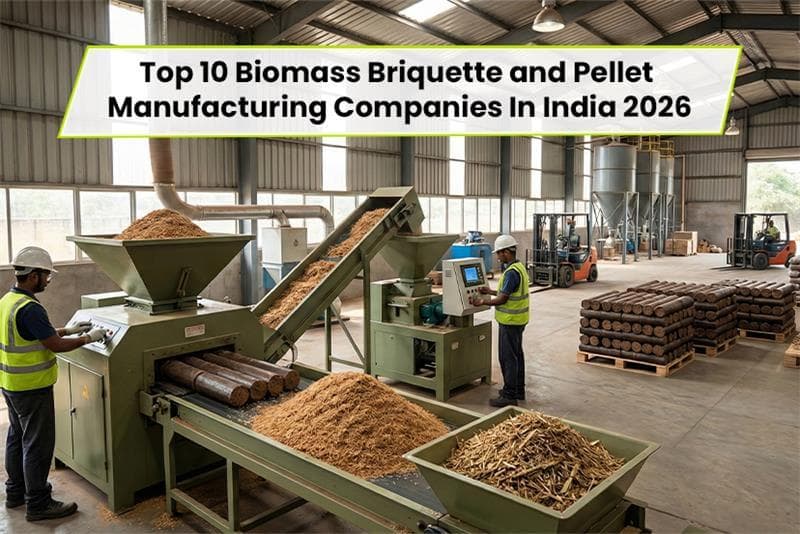
Biomass briquettes and pellets have moved from niche eco-products to mainstream industrial fuel alternatives in India. They substitute coal in boilers and furnaces, help utilities meet co-firing mandates, offer a way to monetize agricultural residues, and reduce stubble-burning pollution. Government tendering for pellets, corporate procurement (power, cement, textiles), and growing export demand have pushed capacity additions and many new regional Biomass briquettes players onto the market. Recent reporting also shows thermal power plants and state programmes still struggling to meet co-firing targets because domestic pellet supply is uneven – a market opportunity for reliable manufacturers.
Check out the list of the Top 10 Briquette and Pellet Manufacturing Companies
1. ECOSTAN Biofuel (Ecostan India Pvt. Ltd.) – consumer & industrial briquettes and pellets
What they make: Wood-based and agro-waste briquettes and pellets for heating and industrial boilers; also packaging and pallet-ready products for bulk shipments.
Why they stand out: Clear product range with online catalog and export capability; well-known brand in the domestic pellet/briquette market. Good for hospitality, small industry, and export customers.
2. Gattuwala Energy Solutions – pellet/briquette machinery
What they make/do: Supplies pellet and briquette machines, offers plant setup services, and also sells pellets and briquettes through partner networks. Useful for entrepreneurs building local pellet plants as well as buyers seeking small-batch supply.
Why they stand out: A Combination of machinery + aggregation helps buyers who want a local, decentralized supply. Gattuwala is frequently cited among 2024 – 25 entrants supporting new pellet plants.
3. NJ Renewable Energy / Pushti group (examples of larger pellet suppliers)
What they make: Industrial wood & agro-pellets for power plant co-firing and process heat.
Why they stand out: Listed among larger wood-pellet manufacturers and exporters; suited for large consumers (power, cement, textiles) that need tonnage and quality consistency.
4. Ronak Engineering (and other equipment + integrated suppliers) – machinery & plant OEMs that also trade fuel
What they make/do: Briquetting and pelletizing machinery, turnkey plant installations, and sometimes direct sales of briquettes/pellets produced at their demonstration or partner units. Good for buyers seeking both equipment and trial production.
5. Regional & registered suppliers (Samarth vendor list examples
What they make: Hundreds of small-to-medium suppliers registered on government vendor lists (Samarth / power ministry) produce briquettes/pellets across states (Punjab, Rajasthan, UP, Maharashtra, etc.). These firms are crucial to state tenders and local supply.
Why they stand out: The Ministry of Power’s Samarth vendor list is often used by utilities and state agencies to shortlist suppliers; it demonstrates the breadth of suppliers available regionally. Buyers running tenders should consult the vendor list for local sourcing.
6. Trade portal sellers & commodity aggregators
What they make/do: Many manufacturers sell via trade portals like Moglix (B2B listings) – these are useful for price discovery and small orders. Portals aggregate many manufacturers’ price offers and product specs. Good for small buyers or initial market scans.
7. Large integrated biomass players & industrial aggregators
What they do: Larger agro-processing, wood processing, or energy companies that bundle pellet/briquette production with other activities (power plants, cogeneration). These suppliers can meet larger monthly tonnages for long-term contracts. Several of the companies listed on manufacturer directories fit this category.
8. Specialist exporters & premium pellet producers
What they make: Torrefied or premium wood pellets for high-efficiency co-firing or export; often certified for calorific value and moisture content. These producers focus on quality standards demanded by some industries and export markets. Directory listings and market reports show a growing segment of premium pellet suppliers.
9. Local briquette specialists
What they make: Cheap, dense briquettes from paddy straw, groundnut shell, rice husk, etc. Target: brick kilns, small boilers, bakeries, and bakeries that use solid fuels. The Samarth registry and many B2B pages list dozens of such suppliers by district.
10. New & fast-growing entrants (machine + fuel combos)
What they do: New companies of 2023–2025 often combine pellet machine sales with offtake agreements to guarantee buyers. These players are practical if you need flexible lot sizes and shorter lead times – they are frequently profiled on market lists and start-up directories.
Different Types of Biomass Briquettes in India and Their Prices (2026 Guide)
Biomass briquettes are compressed solid fuels made from diverse agricultural residues and wood by-products, each offering distinct combustion characteristics and price points depending on raw material, energy content, and processing quality. Common types include sawdust briquettes made from woodworking waste that burn cleanly with relatively low ash, groundnut shell briquettes with high calorific value suited for industrial boilers, mustard husk briquettes which are cost-effective options from mustard cultivation residues, gawar (cluster bean) biomass and paddy straw briquettes that utilise crop residues otherwise burned in fields, agro-waste briquettes combining mixed agricultural remnants, and soyabean husk briquettes derived from oilseed processing.
Types of Biomass Briquettes & Indicative Prices
- Sawdust Briquettes
- Made from compressed sawdust from wood and carpentry waste. Ideal for boilers and industrial heating.
- Price: ₹6–₹10 per kg (₹6,000–₹10,000 per tonne).
- Made from compressed sawdust from wood and carpentry waste. Ideal for boilers and industrial heating.
- Groundnut Shell Briquettes
- Derived from groundnut (peanut) shells; higher calorific value fuel suitable for heavy fuel applications.
- Price: ₹7,000–₹9,000 per tonne (₹7–₹9 per kg).
- Derived from groundnut (peanut) shells; higher calorific value fuel suitable for heavy fuel applications.
- Mustard Husk Briquettes
- Produced from mustard crop residue; economical and widely used in furnaces or boilers.
- Price: ₹5–₹7 per kg (₹5,000–₹7,000 per tonne).
- Produced from mustard crop residue; economical and widely used in furnaces or boilers.
- Gawar (Cluster Bean) Briquettes (price may vary locally)
- Made from guar plant residues, suitable fuel for medium-scale boilers; pricing aligns with common agro-waste ranges (often affordable).
- Approx: ₹5–₹8 per kg (indicative based on similar agro biomass).
- Made from guar plant residues, suitable fuel for medium-scale boilers; pricing aligns with common agro-waste ranges (often affordable).
- Paddy Straw Briquettes
- Utilizes straw left after rice harvest – a low-cost alternative helping reduce open burning.
- Price: Often in the range of ₹5–₹8 per kg, depending on quality/specs.
- Utilizes straw left after rice harvest – a low-cost alternative helping reduce open burning.
- Agro-Waste Briquettes
- Mixed agricultural residues (like cotton stalk, husks) pressed into fuel blocks; flexible, typically cost-effective.
- Price: ₹5–₹7 per kg (~₹6,000–₹7,000 per tonne).
- Mixed agricultural residues (like cotton stalk, husks) pressed into fuel blocks; flexible, typically cost-effective.
- Soyabean Husk Briquettes
- Made from leftover soy processing waste with moderate calorific value and suitable for industrial heating.
- Price: ₹4,300–₹7,500 per tonne (₹4.3–₹7.5 per kg).
- Made from leftover soy processing waste with moderate calorific value and suitable for industrial heating.
Features & specs to check before buying
- Calorific value (kCal/kg): Core metric for fuel replacement calculations. Higher is better.
- Moisture content (%): Target <10% for industrial pellets; lower moisture = higher useful heat.
- Bulk density (kg/m³): Higher density reduces transport cost per unit energy.
- Ash content (%): Low ash (<5–8%) preferred for clean combustion and less slagging.
- Dimensions & uniformity: Pellets (6–8 mm) or briquettes (size) must match your feeder system.
- Fines (%): High fines increase dust and handling losses — aim for low fines.
- Packaging & palletisation: For long supply chains/export, ask for palletised big bags and fumigation certificates if required.
- Sustainability trace & certification: For premium customers or export buyers, certification (sustainability, torrefaction specs) may be required.
- Delivery lead time & seasonal availability: Check harvest cycles and whether the supplier has feedstock storage or year-round supply plans.
- Vendor references & lab reports: Request past offtake references, sample testing, and inspection rights.
Conclusion
Biomass briquettes made from sawdust, groundnut shells, mustard husk, paddy straw, agro-waste, and soyabean residues offer a sustainable, cost-effective alternative to conventional fossil fuels for industrial and commercial energy needs. Each type differs in calorific value, ash content, and pricing, allowing buyers to select the most suitable fuel based on boiler design, availability, and budget. With growing emphasis on clean energy, reduced carbon emissions, and agricultural waste utilization, biomass briquettes are expected to see strong demand across India in 2026 and beyond. Choosing the right briquette type at Business Moglix from a reliable manufacturer not only improves fuel efficiency but also supports circular economy goals and long-term energy sustainability.