








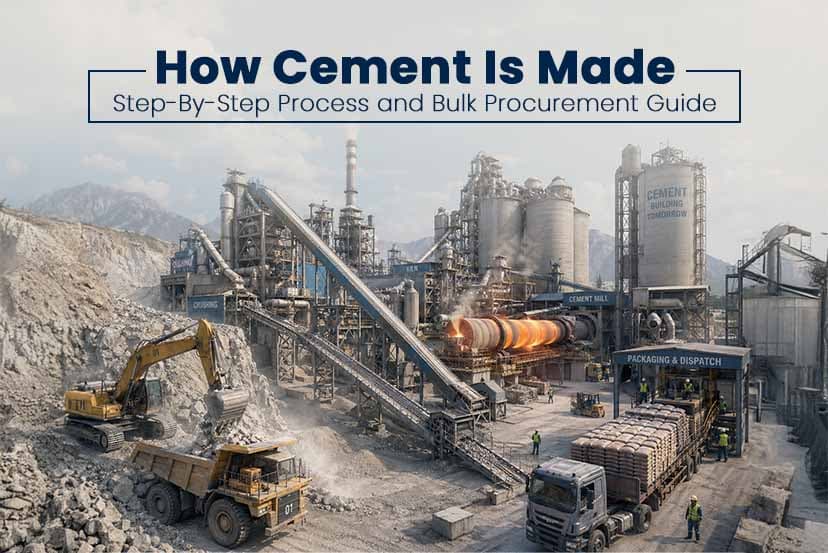
Cement is the foundation of modern construction, used in everything from homes and roads to skyscrapers and bridges. If you’ve ever wondered how cement is made step by step, this guide will walk you through the cement manufacturing process in detail, making it easy to understand for beginners and professionals alike.
In this article, we will cover how cement is manufactured in a factory, the raw materials used, and each stage involved in the cement production process.
What Is Cement and Why Is It Important?
Cement is a fine powder that acts as a binding material when mixed with water, sand, and aggregates to form concrete. It plays a crucial role in ensuring the strength, durability, and stability of structures. Understanding the cement manufacturing process helps builders, engineers, and buyers choose the right material for construction.
Raw Materials Used in Cement Manufacturing
The cement production process starts with carefully selected raw materials:
- Limestone – Main ingredient (70–80%)
- Clay or shale – Provides silica and alumina
- Sand – Enhances silica content
- Iron ore – Improves strength
- Gypsum – Controls setting time
These materials are combined in precise proportions to produce high-quality cement.
How cement is made: Complete and Step-by-Step Process
Let’s break down how cement is made step by step in a typical cement factory:
1. Mining and Extraction
The first step in the cement manufacturing process is extracting raw materials from quarries.
- Limestone and clay are mined using drilling and blasting
- Materials are transported to the factory
This ensures a steady supply for continuous cement production.
2. Crushing and Grinding
Next, large rocks are crushed into smaller pieces:
- Crushers reduce the size to manageable chunks
- Materials are then ground into fine particles
This step prepares raw materials for uniform mixing.
3. Raw Meal Preparation and Blending
In this stage:
- Crushed materials are ground into a fine powder called raw meal
- The mixture is blended in correct proportions
- Homogenization ensures consistent quality
This is a critical step in the cement production process in India and globally.
4. Preheating the Raw Mix
The raw meal is preheated using hot gases:
- Removes moisture
- Initiates chemical reactions
- Improves energy efficiency
Preheating reduces fuel consumption in the kiln.
5. Clinker Formation in Rotary Kiln
This is the most important stage in how cement is manufactured in a factory.
- Raw mix is heated at 1400–1450°C
- Chemical reactions form clinker (hard nodules)
Key reactions:
- Limestone breaks into lime
- Lime reacts with silica and alumina
Clinker is the core material used to make cement.
6. Clinker Cooling
- Hot clinker is cooled using air
- Heat is recovered for reuse
- Cooling stabilizes chemical properties
This step ensures better cement quality.
7. Final Grinding with Gypsum
Now the clinker is converted into cement:
- Clinker is finely ground
- 3–5% gypsum is added
- The final product becomes cement powder
This step determines the fineness and strength of cement.
8. Storage and Packaging
- Cement is stored in silos
- Packed in bags (usually 50 kg)
- Distributed to markets and construction sites
This completes the cement manufacturing process step by step.
Types Of Cement Manufacturing Processes For Various Purposes
There are three main methods used in the cement production process:
Dry Process (Most Common)
- Energy-efficient
- Widely used in modern plants
Wet Process
- Uses slurry form
- Less efficient, rarely used today
Semi-Dry Process
- A combination of both methods
Different Uses of Cement in the Construction Process
Cement is used in multiple applications:
- Building foundations and slabs
- Plastering and masonry
- Road and bridge construction
- RCC (Reinforced Cement Concrete) structures
Choosing the right cement improves durability and performance.
Environmental Impact of Cement Production
The cement manufacturing process has environmental effects:
- Produces CO₂ emissions
- Requires high energy consumption
Sustainable Solutions:
- Green cement
- Alternative fuels
- Reduced clinker usage
- Eco-friendly production technologies
Bulk Procurement of Cement at Moglix Business
For businesses, contractors, and large-scale construction projects, sourcing cement in bulk is crucial for maintaining cost efficiency and ensuring an uninterrupted supply. Platforms like Moglix Business offer a reliable and streamlined solution for bulk cement procurement in India.
Why choose Moglix Business to buy Cement?
- Wide Range of Brands
Access top cement brands in one place, including OPC, PPC, and specialty cement for different construction needs. - Competitive Bulk Pricing
Enjoy discounted rates on large orders, helping reduce overall project costs. - Pan-India Delivery Network
Efficient logistics ensure timely delivery across cities, towns, and remote project sites. - Quality Assurance
All products are sourced from trusted manufacturers, ensuring consistent quality and performance. - Easy Ordering & Support
User-friendly platform with dedicated support for businesses and bulk buyers.
Final Thoughts
Now you clearly understand how cement is made step by step and the complete cement manufacturing process. From raw material extraction to final packaging, each stage plays a crucial role in producing high-quality cement. Whether you run a construction business or any MSME industry, knowing how cement is manufactured in a factory helps you make better construction decisions and find the right cement brand based on your requirements.