








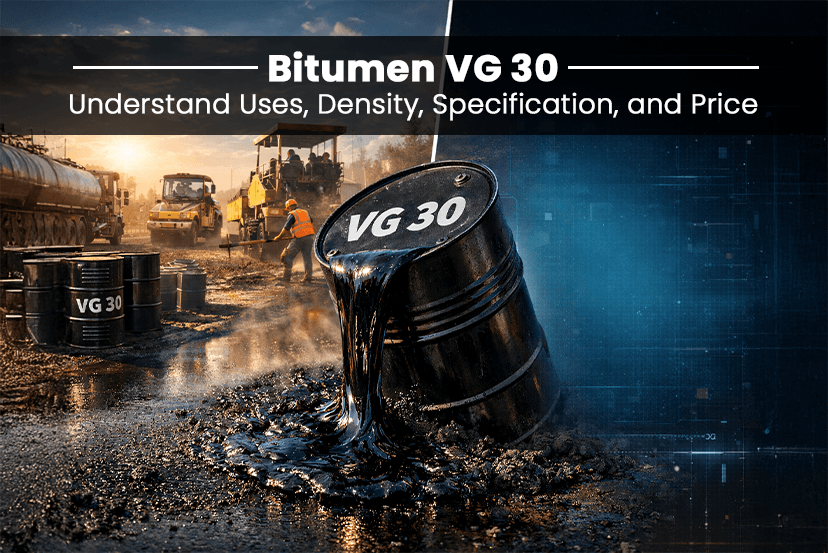
Bitumen VG 30 is one of the most widely used paving-grade bitumen types in road construction and infrastructure projects. Known for its superior viscosity and durability, it plays a crucial role in ensuring long-lasting and high-performance roads. If you are involved in construction, contracting, or procurement, understanding Bitumen VG 30, its properties, applications, and pricing, is essential. This comprehensive guide covers everything you need to know about Bitumen VG 30, including its uses, density, specifications, and market price trends.
What is Bitumen VG 30?
Bitumen VG 30 is a viscosity grade (VG) bitumen as per Indian standards (IS 73). The “VG” stands for viscosity grade, which indicates the material’s resistance to flow at a specified temperature.
VG 30 is a standard paving grade bitumen primarily used for constructing highways and heavy-duty roads that experience high traffic loads.
Key Characteristics:
- Medium viscosity
- Excellent binding properties
- High resistance to deformation
- Suitable for hot and temperate climates
What are the Uses of Bitumen VG 30?
Bitumen VG 30 is widely used in various construction and infrastructure applications due to its strength and performance.
1. Road Construction
The primary use of VG 30 bitumen is in flexible pavement construction. It is ideal for:
- National highways
- State highways
- Urban roads
- Airport runways
2. Asphalt Mix Production
VG 30 is used in preparing hot mix asphalt (HMA), ensuring strong adhesion between aggregates.
3. Heavy Traffic Roads
Due to its viscosity, it performs well under heavy traffic conditions, reducing rutting and deformation.
4. Bituminous Macadam and Dense Bituminous Mixes
It is commonly used in:
- Dense Bituminous Macadam (DBM)
- Bituminous Concrete (BC)
5. Industrial Applications
Apart from roads, VG 30 is also used in:
- Waterproofing
- Roofing solutions
- Industrial coatings
Understand the Density of Bitumen VG 30
Density is an important physical property that helps in understanding the mass-to-volume ratio of bitumen.
Typical Density Range:
- 0.97 to 1.02 g/cm³ at 25°C
Why Density Matters:
- Helps in accurate material estimation
- Important for mix design calculations
- Ensures consistency in construction quality
A higher density generally indicates better binding and durability properties in road construction.
Check out the Specifications of Bitumen VG 30
Bitumen VG 30 must meet specific standards defined by the Bureau of Indian Standards (BIS). Below are the key specifications:
1. Viscosity at 60°C
- Minimum: 2400 Poise
2. Penetration at 25°C
- Minimum: 45 (in 0.1 mm units)
3. Softening Point
- Minimum: 47°C
4. Flash Point
- Minimum: 220°C
5. Ductility at 27°C
- Minimum: 40 cm
6. Specific Gravity
- Approx.: 0.99
7. Loss on Heating
- Maximum: 1%
8. Solubility in Trichloroethylene
- Minimum: 99%
These specifications ensure that VG 30 bitumen performs reliably under varying environmental and load conditions.
Quick look at the Advantages of Bitumen VG 30
1. High Durability: Offers long-lasting performance even under heavy traffic.
2. Temperature Resistance: Performs well in hot climates without softening excessively.
3. Strong Adhesion: Provides excellent bonding between aggregates.
4. Cost-Effective: Widely available and economical compared to modified bitumen.
5. Versatility: Suitable for multiple construction and industrial applications.
Bitumen VG 30 vs Other Grades
| Grade | Best For | Key Difference |
| VG 10 | Cold climates | Lower viscosity |
| VG 30 | Moderate to heavy traffic | Balanced performance |
| VG 40 | Very heavy traffic | Higher stiffness |
VG 30 is the most commonly used grade due to its balanced performance and cost efficiency.
Tentative Price of Bitumen VG 30 in India
The price of Bitumen VG 30 varies based on several factors such as crude oil rates, demand-supply conditions, and location.
Average Price Range (India):
- 55000 to 75000 per metric ton (approximate)
Factors Affecting Price:
- Crude oil prices
- Transportation cost
- Government policies and taxes
- Bulk purchase quantity
- Supplier and location
For bulk procurement, contractors often get better pricing from refineries or authorized distributors.
Conclusion
Bitumen VG 30 is a reliable and widely used paving material that offers excellent performance for road construction and infrastructure development. With its balanced viscosity, durability, and cost-effectiveness, it remains the preferred choice for highways and heavy traffic roads in India.
Understanding its uses, density, specifications, and pricing helps contractors, engineers, and buyers make informed decisions for their projects. So, if you are looking to buy bitumen VG 30 in bulk at the most effective prices, then Moglix Business is the one-stop destination to procure them easily. Whether you are planning a large-scale highway or a local road project, VG 30 bitumen ensures strength, stability, and long-term performance.
Frequently Asked Questions
1. What is VG-30 grade bitumen?
VG-30 is a viscosity-graded bitumen commonly used for road construction, especially in moderate to heavy traffic conditions. It offers good resistance to deformation and performs well in Indian climatic conditions.
2. What is the difference between VG-40 and VG-30 bitumen?
VG-40 is harder and more viscous than VG-30, making it suitable for heavier traffic loads and higher temperatures. VG-30 is comparatively softer and widely used for standard road construction projects.
3. What are the 4 types of bitumen?
The four main types are Penetration Grade Bitumen, Viscosity Grade Bitumen, Cutback Bitumen, and Emulsion Bitumen. Each type is designed for specific applications based on climate, construction needs, and performance.
4. What is the ductility of VG-30 bitumen?
The ductility of VG-30 bitumen is typically a minimum of 40 cm at 27°C as per standards. It indicates the material’s ability to stretch without breaking, ensuring flexibility in pavements.