









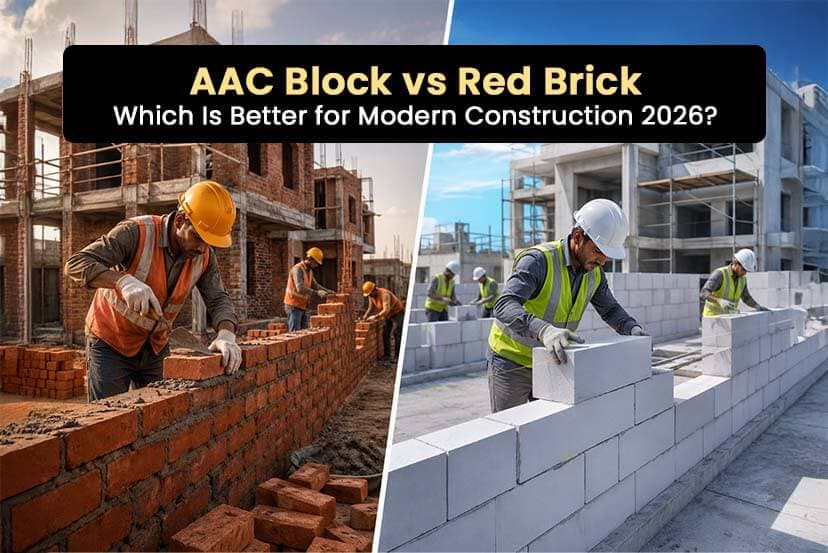
The construction industry has evolved significantly over the years, introducing innovative building materials that improve efficiency, durability, and sustainability. Among the most commonly used wall construction materials today are AAC blocks (Autoclaved Aerated Concrete blocks) and traditional red bricks. While red bricks have been the preferred choice for centuries, AAC blocks are rapidly gaining popularity due to their lightweight structure and superior performance characteristics. Businesses and industries mostly get confused about whether to buy AAC blocks or red bricks for infrastructure. However, you can simply buy both materials at the business Moglix, based on requirements.
Choosing between AAC blocks and red bricks can significantly impact the cost, strength, energy efficiency, and overall quality of a building. This guide provides a detailed comparison of AAC blocks vs red bricks to help builders, contractors, architects, and homeowners make an informed decision.
What Are AAC Blocks?
AAC (Autoclaved Aerated Concrete) blocks are lightweight, precast building materials made from cement, lime, sand, gypsum, and aluminum powder. These materials undergo a high-pressure steam curing process in an autoclave, creating millions of tiny air pockets within the blocks.
The result is a strong yet lightweight building material that offers excellent thermal insulation, fire resistance, and ease of installation.
Key Features of AAC Blocks
- Lightweight structure
- High thermal insulation
- Excellent soundproofing
- Fire-resistant properties
- Environment-friendly manufacturing
- Uniform shape and size
- Faster construction process
What Are Red Bricks?
Red bricks are traditional construction materials manufactured from natural clay. The clay is molded into brick shapes, dried, and fired in kilns at high temperatures to achieve hardness and durability.
Red bricks have been used for centuries in residential, commercial, and industrial construction due to their availability and proven strength.
Key Features of Red Bricks
- High compressive strength
- Long service life
- Easy availability
- Traditional construction material
- Suitable for load-bearing structures
- Good resistance to weather conditions
AAC Block vs Red Brick: Detailed Comparison
1. Weight
AAC blocks are significantly lighter than red bricks because of their cellular structure.
| Parameter | AAC Block | Red Brick |
| Density | 550–650 kg/m³ | 1800–2000 kg/m³ |
| Weight | Lightweight | Heavy |
Winner: AAC Blocks
The reduced weight lowers the dead load on the structure, resulting in savings on foundation and structural costs.
2. Compressive Strength
Compressive strength determines a material’s ability to withstand loads.
| Parameter | AAC Block | Red Brick |
| Compressive Strength | 3–7 MPa | 3.5–10 MPa |
Winner: Red Bricks
Red bricks generally offer slightly higher compressive strength, making them suitable for load-bearing applications.
3. Thermal Insulation
AAC blocks contain numerous air pockets that act as thermal barriers.
| Parameter | AAC Block | Red Brick |
| Thermal Conductivity | Low | Higher |
| Heat Resistance | Excellent | Moderate |
Winner: AAC Blocks
Buildings constructed with AAC blocks remain cooler during summers and warmer during winters, reducing energy consumption.
4. Sound Insulation
Noise reduction is an important consideration in modern construction.
| Parameter | AAC Block | Red Brick |
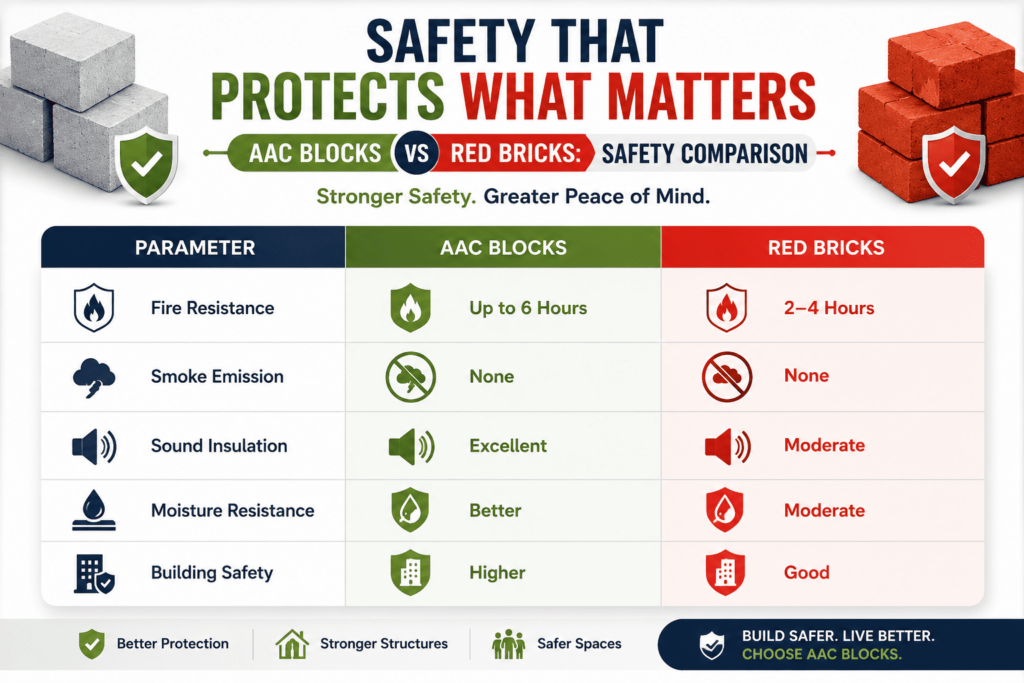
| Sound Insulation | Excellent | Moderate |
Winner: AAC Blocks
The porous structure effectively absorbs sound, making AAC blocks ideal for residential apartments, hospitals, and educational institutions.
5. Fire Resistance
Fire safety is a critical factor for any construction project.
| Parameter | AAC Block | Red Brick |
| Fire Resistance | Up to 4–6 Hours | Around 2–4 Hours |
Winner: AAC Blocks
AAC blocks provide superior fire protection and improve building safety.
6. Water Absorption
Excessive water absorption can lead to dampness and structural issues.
| Parameter | AAC Block | Red Brick |
| Water Absorption | Moderate | Higher |
Winner: AAC Blocks
AAC blocks absorb less moisture compared to conventional clay bricks when properly installed.
7. Construction Speed
AAC blocks are larger than standard bricks and easier to handle.
| Parameter | AAC Block | Red Brick |
| Installation Speed | Faster | Slower |
| Mortar Consumption | Lower | Higher |
Winner: AAC Blocks
Larger block sizes reduce the number of joints, speeding up construction.
8. Cost Comparison
The material cost alone does not provide the complete picture.
| Parameter | AAC Block | Red Brick |
| Initial Material Cost | Slightly Higher | Lower |
| Overall Construction Cost | Lower | Higher |
Winner: AAC Blocks
Although AAC blocks may have a higher purchase cost, they reduce expenses related to mortar, plaster, labor, transportation, and structural steel.
9. Environmental Impact
Sustainable construction materials are increasingly preferred worldwide.
| Parameter | AAC Block | Red Brick |
| Resource Consumption | Lower | Higher |
| Carbon Footprint | Lower | Higher |
| Eco-Friendly | Yes | Moderate |
Winner: AAC Blocks
AAC block manufacturing consumes fewer natural resources and generates less environmental impact.
10. Durability
Both materials provide long-term durability when properly installed.
| Parameter | AAC Block | Red Brick |
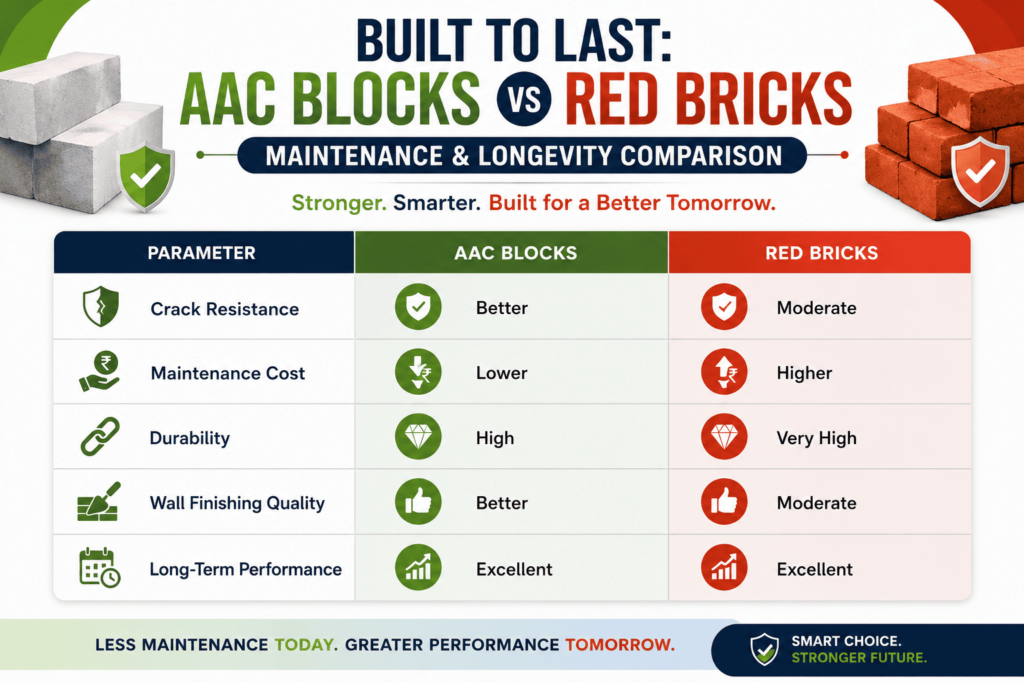
| Lifespan | 50+ Years | 75+ Years |
| Durability | High | Very High |
Winner: Red Bricks
Red bricks have a long-established track record of durability in various climatic conditions.
What are the Advantages of AAC Blocks and Red Bricks?
- Lightweight Construction: AAC blocks are up to 30% lighter than red bricks, reducing the overall structural load and foundation costs.
- Superior Thermal Insulation: Their porous structure minimizes heat transfer, helping maintain comfortable indoor temperatures and reducing energy consumption.
- Faster Construction: Larger block sizes and precise dimensions enable quicker installation and lower labor requirements.
- Cost-Effective Installation: AAC blocks require less mortar and plaster, resulting in savings on materials and construction costs.
- Fire & Sound Resistance: They offer excellent fire protection and sound insulation, making buildings safer and more comfortable.
Red Bricks
- Higher Strength: Red bricks provide excellent compressive strength, making them suitable for heavy-duty construction applications.
- Long-Lasting Durability: They have a proven track record of durability and can withstand various weather conditions for decades.
- Ideal for Load-Bearing Walls: Their dense composition makes them a reliable choice for structures requiring strong load-bearing capacity.
- Easy Availability: Red bricks are widely available across regions, ensuring easy sourcing for construction projects.
- Better Impact Resistance: Their solid and dense structure offers greater resistance to physical impacts and wear over time.
Understand the Applications of AAC Blocks
AAC blocks are commonly used in:
- Residential buildings
- Commercial complexes
- Hospitals
- Educational institutions
- Industrial buildings
- High-rise structures
- Green building projects
Red Bricks
Red bricks are widely used in:
- Residential homes
- Boundary walls
- Load-bearing walls
- Historical restorations
- Small-scale construction projects
- Traditional architecture
Conclusion
The debate between AAC block vs red brick ultimately comes down to balancing performance, cost, and project requirements. While red bricks continue to offer excellent strength and durability, AAC blocks provide superior insulation, faster construction, lower structural load, and enhanced sustainability. As the construction industry moves toward energy-efficient and eco-friendly building practices, AAC blocks are becoming the preferred choice for modern infrastructure projects. If you are looking to buy construction aggregates like AAC blocks or Red brick in bulk at the most reasonable prices, you can simply procure them through Moglix Business.
By evaluating factors such as strength, budget, climate conditions, and building design, you can select the material that best aligns with your construction goals.